Textile Recycling or the Art of Composting
When it comes to disposing of an old cotton T-shirt in a responsible way, there are a number of challenges to overcome. Even sustainably produced and certified textiles can only be recycled to a limited extent. This article explains why this is the case and the approach we at Cotonea are taking.
The Challenge: The Physics of Textile Recycling
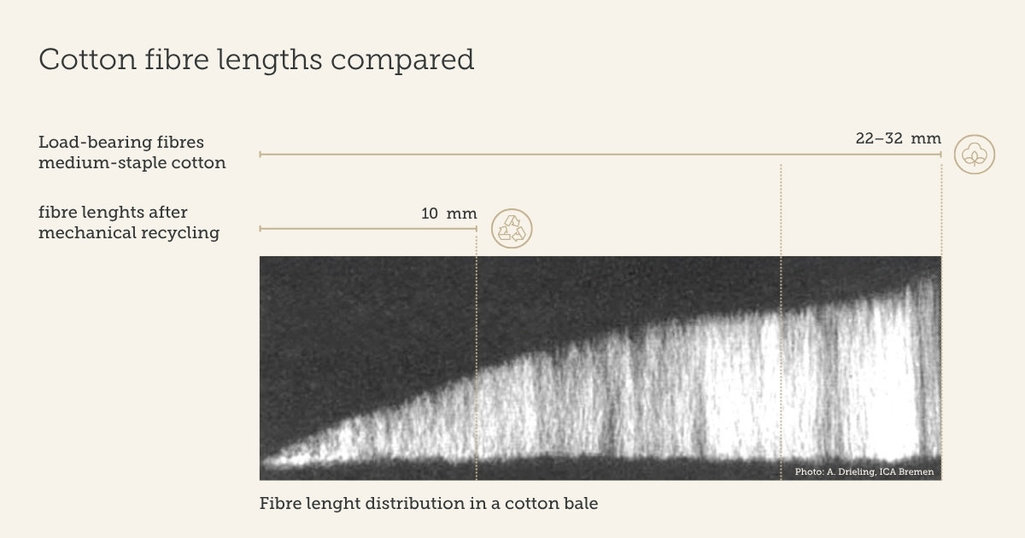
Anyone discussing cotton recycling needs to be familiar with the underlying conditions and physical processes involved. A cotton boll contains fibres of varying lengths: short fill fibres and long carrier fibres. The long fibres provide the yarn with stability, strength and texture. In medium-staple cotton, which is the most widely processed type worldwide, these fibres are between 22 and 32 millimetres long.
In mechanical recycling, machines tear textiles back down into individual fibres. This tearing shortens the cotton fibres to less than 10 millimetres.. This is at least half to two-thirds shorter than the 22 to 32 millimetres of medium-staple cotton.
However, the quality, comfort and durability of most textiles depend on the proportion of long fibres. These determine the feel, softness and strength – and whether a garment still performs well even after many washes.
This is why we remove the very short fibres (7 millimeters and below) during spinning cotton fibres into yarn. They would reduce the quality of the yarn as well as the fabrics later made from it. These so called comber noils go into other applications, such as the production of bank notes.
At up to 8 to 10 millimetres, recycled fibres are not much longer than these comber noils. Some fabrics such as molleton, flannel or denim can cope with shorter fibres, but they don’t work for fine, long-lasting fabrics.
Anyone who mechanically recycles cotton ends up with fabrics with significantly poorer properties because the fibres are shortened. Strictly speaking, this is downcycling. After all, recycling is actually meant to create a cycle in which raw materials are reused as often as possible, as is the case with glass or metal.
The Solution: Natural Cycle
Technology continues to progress. The open-end spinning (OE) process now allows three previously separate production steps to be combined into one. This makes it possible to process significantly more short, recycled fibres into yarn. Regardless of the issue of recycling, the new process represents a considerable step forward. Nevertheless, it cannot overcome the physical limitations of short and long fibres. In the case of cotton, the mechanical route within the industrial cycle inevitably leads to downcycling.
The only solution currently available is the cycle of nature / natural cycle. As a natural material, cotton can be composted completely and without leaving any residue at the end of its life cycle. Provided it has been processed appropriately.
This is where many products fall short, even before recycling is even considered. The iVN Best Standard, under which we at Cotonea certify the majority of our products, sets one of the strictest benchmarks in this regard: anything that is potentially harmful remains prohibited. This applies to many dyes, finishes and treatments that are still permitted elsewhere but prevent true circularity.
Remaining Details: Sewing Threads & More
There is one further detail that may seem minor but is important: even a T-shirt that meets all the above requirements needs tear-resistant threads for sewing.
That is why most sewing threads have a synthetic fibre core. This is not due to negligence, but because there is as yet no equivalent alternative for seams with sufficient tear resistance. At present, these still need to be cut out before composting, much like other non-compostable components such as zips.
We are actively seeking an industrial partner that manufactures sewing threads with a biopolymer core in order to resolve this compromise.
As with all sustainable processes, textile manufacturing also requires the proper attitude. Rather than quick, maximum profit, what counts is long-term sustainability, quality and fair conditions for people and the environment.
At Cotonea we avoid using recycled fibres because cotton is better off in the cycle of nature than in industrial recycling, and the shorter fibres compromise quality and longevity.
That is why we are critical of a possible mandatory quota for recycled cotton, as is currently being discussed under the Ecodesign for Sustainable Products Regulation (ESPR). A fixed share of recycled fibres would reduce quality, longevity and durability.
What This Means for Choosing a Textile
A textile can be returned to the cycle of nature if it is certified to iVN Best or Cradle to Cradle standards (although, in the case of C2C, not every partial certification or stage is sufficient) and non-compostable components are removed beforehand. This requires that a textile has been designed with this in mind from the outset.
Durability and biodegradability are not mutually exclusive. They are two sides of the same decision, which begins with the design.